

Mainz. From November 28, 2025, to February 22, 2026, the Gutenberg Museum in Mainz will present the first comprehensive exhibition to date devoted exclusively to the fascinating topic of printer’s marks—the predecessors of today’s publishing logos.
Entitled ICH DRUCKE! Signet, Marke und Druckerzeichen seit dem Zeitalter Gutenbergs (I PRINT! Signets, brands, and printers’ marks since the time of Gutenberg), the special exhibition focuses on printers’ marks, which have received little attention in the history of book printing to date.
Printers’ marks are small pictorial symbols that have adorned the first or last page of a book since the invention of letterpress printing and served as a calling card for printers and publishers. They were more than mere trademarks; they were an expression of identity, education, piety, wit, and corporate culture.
The Gutenberg Museum preserves a significant collection of around 2,000 printer’s marks. Gustav Mori, a researcher and trained printer, collected these items in the first half of the 20th century as a loose-leaf collection—a widespread practice at the time. The exhibition presents the collection to the public for the first time.
However, the printer’s marks are not presented as isolated objects. Rather, they are embedded in historical contexts that trace the emergence and ongoing transformation of the world of printers and publishers. The exhibition unfolds through a color-intensive presentation and connects historical printers’ marks with today’s publishing logos. They were the first ‘logos’ in the printed book industry. Their significance for identity and brand building is still relevant today. ‘Printer’s marks are a reflection of their time. They show how printers presented themselves, how they built trust, and how they positioned themselves in the competitive market’, say curators Prof. Dr. Hui Luan Tran (Johannes Gutenberg University Mainz) and Dr. Nino Nanobashvili (Gutenberg Museum Mainz). ‘These small images tell stories about identity and market conditions, about power structures, religion, and education. They connect us with the people behind the books who have shaped our culture.’
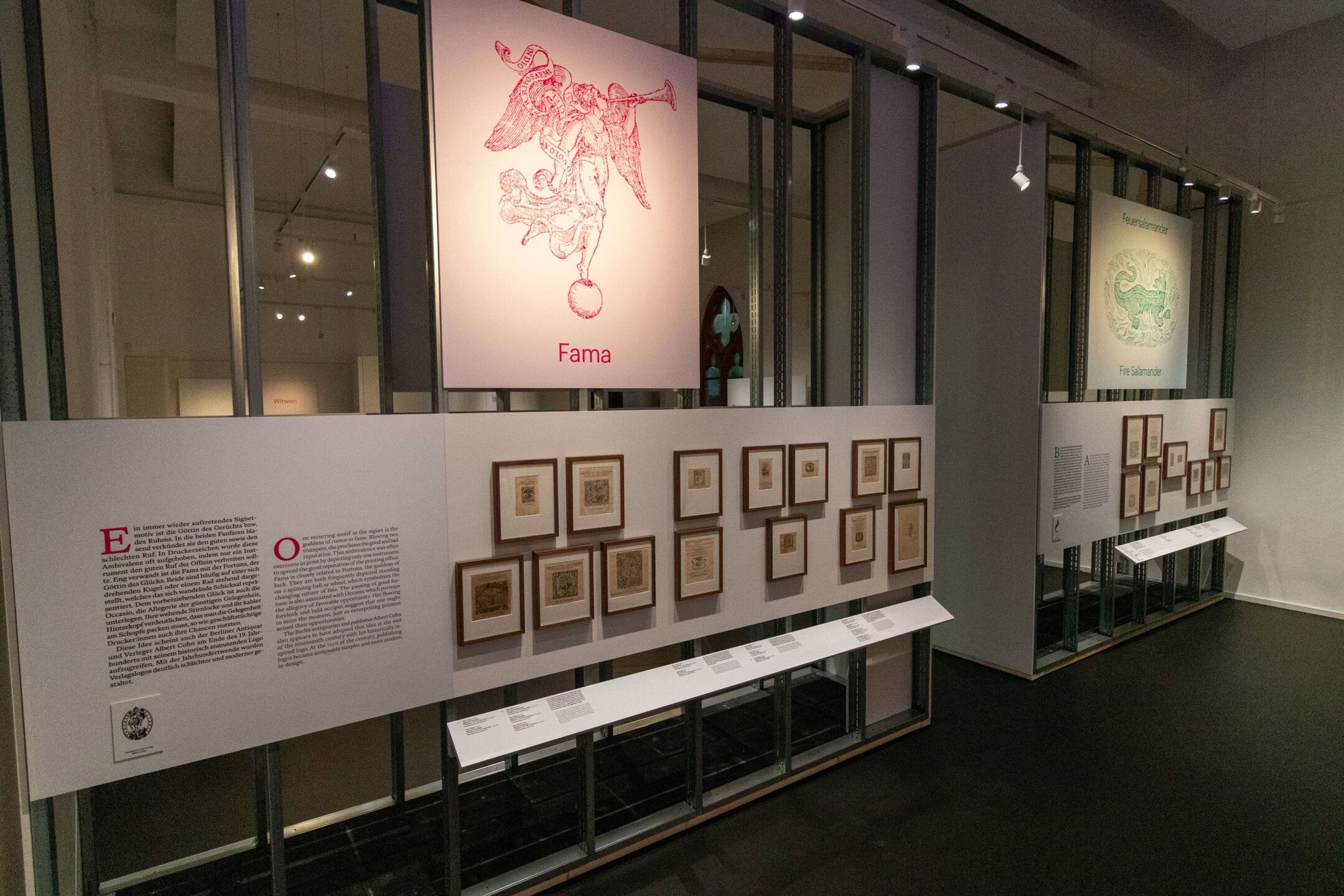
The special exhibition was created in cooperation with the Department of Art History at Johannes Gutenberg University Mainz. The extensive collection was digitized at the university’s Digitization and Photo Documentation Service Center and catalogued in the internal database by academic staff. After the exhibition opens, a database designed specifically for this purpose will make the collection available to the interested public. This will be provided by the Gutenberg Museum. ‘The exhibition focuses on an important part of the Gutenberg Museum’s collection on the history of books. It is an outstanding result of the museum’s close cooperation with researchers, academic institutions, and renowned sponsors’, emphasizes museum director Dr. Ulf Sölter.
The special exhibition was financed largely by third-party funds and by national and international foundations, including the Art Mentor Foundation Lucerne, the Ernst von Siemens Art Foundation, the Tavolozza Foundation, the Rhineland-Palatinate Foundation for Culture, and the Rheinhessen Sparkasse. ‘In recent years, the state has already enabled various successful projects at the Gutenberg Museum—from the acquisition of an outstanding block book to expand its collection, to the purchase of the necessary technology for digitizing the museum’s collection. The Rhineland-Palatinate Foundation for Culture also supported the Gutenberg Museum’s special exhibition with project funding. This clearly demonstrates the great importance that Rhineland-Palatinate attaches to the Gutenberg Museum’, said Minister of Culture Katharina Binz.
A comprehensive companion volume to the exhibition was published in cooperation with Deutscher Kunstverlag. In addition to introductory articles on the medium of printers’ marks and the history of the Gutenberg Museum’s collection, the publication offers deep insights into various aspects of the art of printing.
Topics such as the role of widows as printers, an impressive collection of printing blocks in Antwerp, the self-presentation of Ukrainian printers, and the development of the publishing house logo by Deutscher Kunstverlag are presented in a comprehensive context.
The special exhibition is accompanied by a diverse supporting program that addresses various aspects of printing symbols. This ranges from guided tours by the exhibition curators and students from Johannes Gutenberg University Mainz to academic lectures. One highlight is the panel discussion on January 22, 2026, with representatives from the publishing world on design issues relating to current logos.
Ludwig Holle, head of the building department of the city of Mainz, sees the opening of the special exhibition as an important milestone for the Gutenberg Museum: ‘After the complex move last year and the successful opening of the interim exhibition Gutenberg Museum MOVED, opening the first major special exhibition in the new premises is another successful step for the museum. We are looking forward to further projects that promise active work during the interim period’
Exhibition
I PRINT! Signets, brands, and printers’ marks since the time of Gutenberg.
Gutenberg Museum MOVED
Reichklarastraße 1.
55116 Mainz, Germany
November 28, 2025 to February 22, 2026