View fullsize
Due to the state of lithographic printing technique and manufacturing of printing colours around 1840, printing houses usually used more than four stones for colour lithography. It was easier and cheaper to print colour lithographs from a greater number of stones. Engelmann had used crayon all over, but gradually it was replaced by ink and differing dotting techniques. You can say that the development of the print went from the primary elements dot, line and surface over the halftone cliché to the dot, now called pixels. The efforts of the lithographers to get halftone effects led to the halftone cliché in the end of the 19th century. And not before that time the trichromatic method became the norm. For colour lithography the use of many colour stones was the normal and time consuming procedure.
The abolishment of the trade guilds in 1846 made it easier for trade and industry in Sweden to develop, even if there still were restrictions. The need for commercial prints gave the printing trade a growing market. But even if only a few lithographic establishments had the capacity to print with colours, it was exceptions. Most lithographs, may it be pictures or commercial prints, were printed in black, sometime with one or two more colours. But slowly chromolithographs became more frequent. A. J. Salmson printed his first chromolithographs in 1847, followed by J. F. Meyer next year.
Chromolithographs were then sparsely printed in the 1850-ies and 1860-ies.
In 1841 the German lithographer Johann Friedrich Meyer started a lithographic establishment, J. F. Meyer & Co Litografiska Institut, that is lithographic institute. Its main business branch was commercial prints as tobacco or wine labels, business and visiting cards or bill forms.
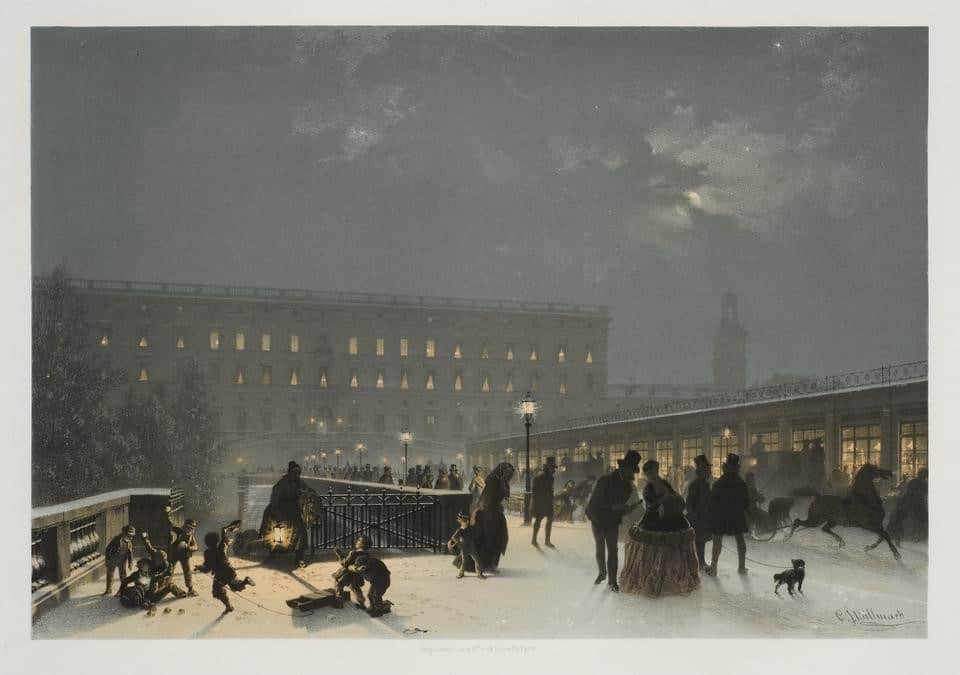
In 1844 Axel Jakob Salmson established a lithographic establishment which would be a severe competitor to J. F. Meyer. Salmson had studied in the Royal Academy. After working in the workshop of Gjöthström & Magnusson he started at his own. Together with J. F. Meyer & Co. A. J. Salmson was the most successful lithographic establishment during the 1850-ies. Both firms used the latest technique and hired experienced specialists, often from Germany. Salmson opened a shop at the Bazaar on the Norrbro (The Northen Bridge) in front of the Royal Castle in Stockholm, here viewed by Carl Johan Billmark, at this time the most prominent Swedish artist working in lithography. As he could not find sufficiently good printers in Sweden he had early moved to Paris and printed his lithographs by Lemercier, one of the most important lithographic printing houses in Paris.